
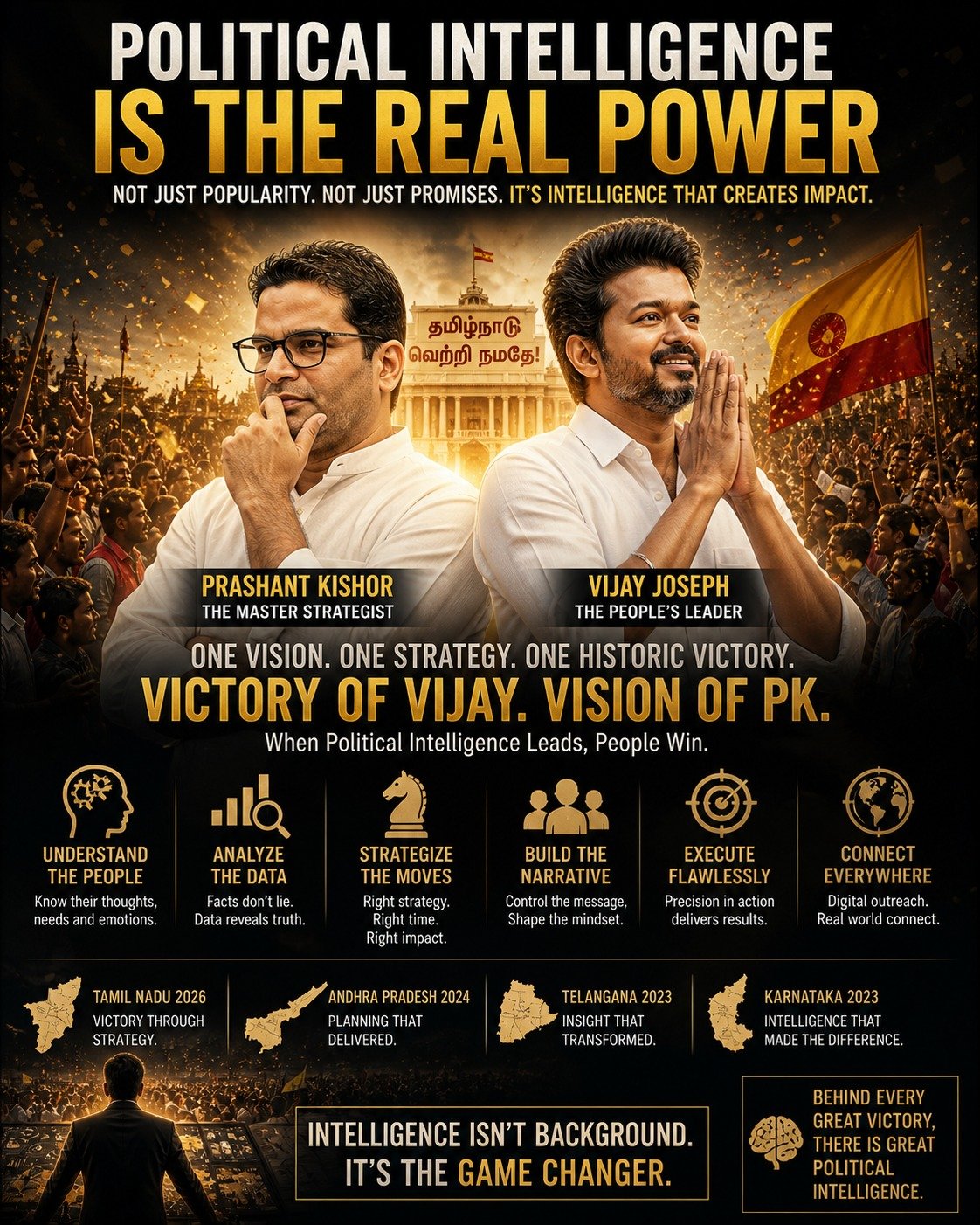
Everyone is celebrating the victory of TVK leader Vijay Joseph, who has been elected as the new Chief Minister of Tamil Nadu. Behind this remarkable win stands the mastermind strategist, Prashant Kishor.
Previously, he played a key role as the political strategist for DMK during the 2021 elections, contributing significantly to their victory and formation of government. However, post-elections, certain remarks made by DMK members against Bihari communities drew criticism. In response, Prashant Kishor, identifying strongly with his roots, stood firmly in support of Biharis.
Months later, he made a bold prediction that Vijay would emerge victorious in the upcoming elections. At the time, many—including myself—dismissed his statement. Yet, he remained committed to his vision and meticulously strategized Vijay’s political journey, ultimately leading to a decisive and high-margin victory.
This is not merely about bold statements; it is about the power of political intelligence.
Many politicians believe that their personal connection with the public is enough to win elections. However, modern politics has evolved far beyond that. Today, success in politics demands structured intelligence, data-driven strategies, and deep voter insights. Emotional appeal alone is no longer sufficient—strategic thinking is what truly influences public sentiment.
We have seen this shift not only in Tamil Nadu, but also in Andhra Pradesh (2024 elections), and in Telangana and Karnataka during the 2023 elections. Political intelligence has become the backbone of every successful campaign. While parties may have agendas, these agendas are often shaped, refined, and executed by intelligence-driven strategies.
But what about leaders themselves?
Leaders, too, must develop political intelligence. It enables them to understand constituency dynamics, interpret public sentiment accurately, and make informed decisions. While many leaders believe they can directly connect with people and resolve issues on their own, the reality is far more complex.
A strong political ecosystem requires coordination. Leaders need trusted political associates who can observe, document, and relay ground-level developments. This information is then analyzed by the intelligence team, which crafts strategies accordingly. When this system functions effectively, decisions align with public expectations, and outcomes fall into place seamlessly.
In today’s political landscape, intelligence is not an option , it is a necessity.